Selecting reliable manufacturers matters when a helipad safety net must perform under wind, weight, and repeated use. This guide introduces ten leading China Helipad Safety Netting manufacturers for buyers, contractors, and aviation facility managers. It focuses on practical evidence, not attractive catalogs alone.
The comparison considers net strength, rope or webbing materials, edge reinforcement, anchor systems, and dimensional accuracy. It also reviews factory experience, quality-control procedures, customization ability, and export communication. Clear product drawings can prevent costly mistakes. Inspection records, load-test documentation, and material certificates deserve careful attention before purchase. Experienced suppliers should explain installation details, maintenance intervals, and replacement procedures in precise language.
No ranking is flawless. Manufacturer capabilities can change, and published specifications may not show real field performance. Details matter. Buyers should verify current certifications, test methods, project references, and applicable aviation requirements independently. A strong supplier may still need a local engineering review for unusual deck layouts, coastal climates, or high-wind locations. Stainless steel hardware, UV-resistant fibers, and drainage-friendly designs can improve service life, but no material removes every maintenance obligation. This overview offers a practical starting point rather than a final purchasing decision. It combines manufacturing knowledge with a cautious evaluation approach, helping readers compare China-based suppliers with greater confidence. Photographs, sample inspections, and direct technical discussions can reveal weaknesses that online descriptions conceal. That extra step is sometimes overlooked. It should not be.
China Top 10 Helipad Safety Netting Manufacturers
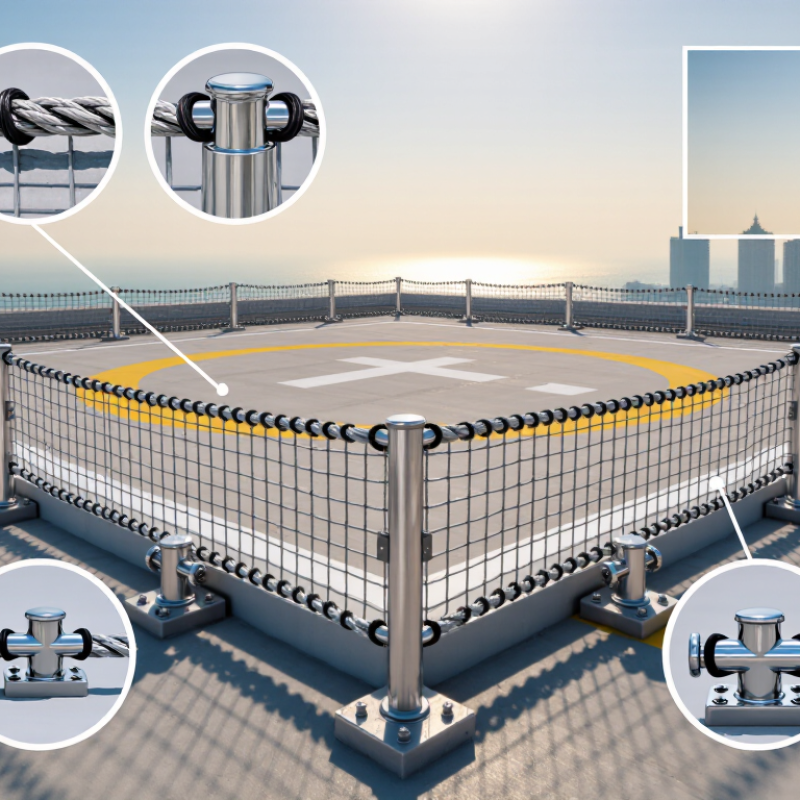
Helipad safety netting provides a secondary escape surface beside the landing area. It helps reduce fall exposure during boarding, maintenance, and emergency movement. The net must remain tensioned, corrosion-resistant, and free from sharp projections. Small details matter.
The UK Civil Aviation Authority’s CAP 437, 9th edition, specifies a minimum perimeter net width of 1.5 metres for offshore helidecks. FAA AC 150/5390-2C gives a comparable five-foot width for elevated heliport safety areas. These dimensions are not decorative targets. They support controlled movement when a person steps beyond the marked deck. Mesh openings, edge ropes, brackets, and drainage points should also prevent foot traps and equipment snagging.
Design should match the site, not only the catalogue. Offshore installations face salt spray, wind loading, ultraviolet exposure, and repeated helicopter turbulence. Onshore roofs may need stronger interfaces with parapets and access ladders. EN 795 testing principles can help evaluate anchor performance, although they do not replace aviation-specific approval. A useful inspection record should include mesh damage, tension, fastener loosening, and corrosion depth. Check after severe weather.
A common weakness is assuming a compliant width guarantees safety. It does not. Poor installation, hidden corrosion, or an uneven deck can still create serious hazards. Standards provide a baseline; competent inspection provides confidence.
| No. | Safety Netting Parameter | Typical Technical Requirement | Safety Purpose | Relevant Reference | Verification Point |
|---|---|---|---|---|---|
| 1 | Primary Function | A secondary fall-arrest and personnel-retention system installed around an exposed helipad or helideck perimeter. | Helps prevent personnel, tools, and small loose objects from falling from the deck edge. | ICAO Annex 14; applicable national aviation regulations | Confirm that the net is treated as a supplementary safeguard, not a replacement for guardrails or safe operating procedures. |
| 2 | Perimeter Coverage | Continuous coverage should be provided along exposed edges, access gaps, and other areas identified by the risk assessment. | Reduces unprotected edge sections where a person or object could pass through. | ICAO Annex 14; local civil aviation authority requirements | Check drawings and installation records for full perimeter continuity. |
| 3 | Outward Projection | A commonly specified helideck arrangement projects approximately 1.5 m outward from the deck edge, subject to the governing aviation authority and project design. | Provides a catch zone beyond the edge and increases the likelihood of retaining a falling person. | UK CAA CAP 437 and project-specific requirements | Measure the installed projection and compare it with approved design drawings. |
| 4 | Net Inclination | The net is commonly designed to slope downward and outward by no more than approximately 10° from the deck edge, where required by the applicable helideck guidance. | Supports controlled load transfer and helps prevent a person from rolling back onto the deck. | CAP 437; authority-approved engineering design | Verify the angle with a site measurement and inspect for sagging or reverse slopes. |
| 5 | Mesh Configuration | Mesh size, knot construction, rope diameter, and edge reinforcement must be selected to prevent unacceptable openings and snagging hazards. | Retains personnel and equipment while limiting entanglement and passage through the net. | EN 1263-1 where applicable; project specification | Review mesh dimensions, sample testing, and product traceability documents. |
| 6 | Material Selection | UV-stabilized synthetic rope or corrosion-resistant wire-rope systems are commonly considered, depending on exposure, fire risk, and engineering requirements. | Improves resistance to sunlight, salt spray, moisture, temperature changes, and outdoor aging. | EN 1263-1; ISO 4892-3 for UV exposure testing where specified | Request material certificates, UV-resistance information, and corrosion-protection details. |
| 7 | Perimeter Rope and Anchors | The net should be continuously secured to a designed perimeter rope, cable, or structural support using corrosion-resistant fittings and engineered anchor spacing. | Transfers impact forces to the supporting structure and prevents local detachment. | EN 1263-2; structural design and marine-environment specifications | Inspect anchor bolts, terminations, shackles, tension, and evidence of galvanic corrosion. |
| 8 | Load and Energy Performance | The selected system should have documented static, dynamic, or energy-absorption performance appropriate to the intended fall scenario and support arrangement. | Confirms that the net and its supports can manage design loads without unacceptable failure or excessive deflection. | EN 1263-1; engineered load calculations | Check test reports, design calculations, and compatibility between net, anchors, and deck structure. |
| 9 | Inspection and Maintenance | Inspection should cover cuts, abrasion, UV degradation, loose stitching, damaged fittings, corrosion, excessive sag, and unauthorized alterations. | Identifies deterioration before it reduces the system's retention or load-bearing capability. | EN 1263-1; operator maintenance program; OSHA 29 CFR 1926.502(c) where applicable | Maintain dated inspection records and remove damaged components from service until assessed. |
| 10 | Operational Compatibility | The arrangement must not obstruct helicopter approach paths, rotor clearance, access routes, drainage, firefighting equipment, lighting, fuel systems, or emergency egress. | Preserves safe aircraft operations and emergency response capability. | ICAO Annex 14; CAP 437; local helipad approval conditions | Complete an aviation safety review after installation and after any modification. |
Note: Dimensions and performance requirements must be confirmed against the approved helipad design, aircraft operating category, local civil aviation authority rules, environmental conditions, and the applicable edition of each referenced standard.
It provides a secondary escape surface beside the landing area. It helps reduce fall exposure during boarding, maintenance, and emergencies.
Common aviation guidance uses a minimum width of about 1.5 meters, or five feet. Local requirements may differ.
Mesh openings should prevent foot traps. Edge ropes, brackets, and drainage points should not snag clothing or equipment.
Offshore nets face salt spray, strong winds, ultraviolet exposure, and helicopter turbulence. Materials should resist corrosion and repeated handling.
Attachment points must match the platform structure and expected working loads. Onshore roofs may need stronger interfaces with parapets and ladders.
Record mesh damage, net tension, loose fasteners, and corrosion depth. Inspect again after severe weather. Small details matter.
Request exact material details, mesh sizes, edge-rope strength, attachment drawings, and recognized laboratory test reports. Generic certificates are not enough.
A sample reveals uneven mesh spacing, weak stitching, loose fittings, and poor coatings. Check it by hand.
No. Poor installation, hidden corrosion, uneven decking, or incompatible fittings can still create serious hazards.
Review production records, quality procedures, packaging, response times, and replacement guidance. Fast is not always safe. Independent verification remains worthwhile.
This guide presents China Helipad Safety Netting as a critical component of rooftop and elevated landing-zone protection. It explains how properly designed netting helps reduce fall risks, supports safe access around helipad edges, and complements other aviation safety measures. The article also outlines essential design factors, including load capacity, visibility, flame resistance, weather durability, edge protection, and compliance with applicable safety standards.
It further introduces ten leading types of Chinese manufacturers by product specialty, without focusing on brand names, and explains how buyers can evaluate production capability, material quality, testing procedures, installation methods, and customization services. Readers will learn about commonly used synthetic and metal materials, attachment systems, color and size options, quality-control processes, certification documentation, pricing considerations, packaging, lead times, and export support. The goal is to help project owners, contractors, and distributors compare suppliers objectively and select reliable helipad safety netting solutions for different operational and environmental requirements.

 LvXing