Choosing the best China Helideck Safety Net supplier requires more than comparing prices and product photographs. A helideck safety net protects people, equipment, and aircraft during demanding operations. It must perform reliably under wind, rain, ultraviolet exposure, salt air, and repeated foot traffic. The right supplier should understand these conditions through practical manufacturing experience. They should provide clear material specifications, accurate dimensions, connection details, and installation guidance. Ask whether the net uses suitable marine-grade materials, reinforced borders, corrosion-resistant fittings, and consistent mesh construction. These details often reveal more than polished marketing language.
A reliable China Helideck Safety Net supplier should also support its claims with test reports, quality records, and traceable production information. Independent inspection can strengthen confidence, especially when projects involve offshore platforms or severe weather. Check previous projects, customer references, factory capabilities, and response times before making a decision. A serious manufacturer should discuss loading requirements, edge protection, drainage, maintenance, and replacement planning. Do not accept vague promises.
Small details matter.
For example, poorly finished stitching may weaken after months of vibration and sunlight. A supplier may offer an attractive quotation, yet omit packaging, installation support, or testing costs. That price is not always economical. No supplier is perfect, and documents alone cannot replace careful technical review. Buyers should compare evidence, not assumptions. A thoughtful selection process reduces avoidable risks and supports long-term helideck safety, operational continuity, and responsible procurement.
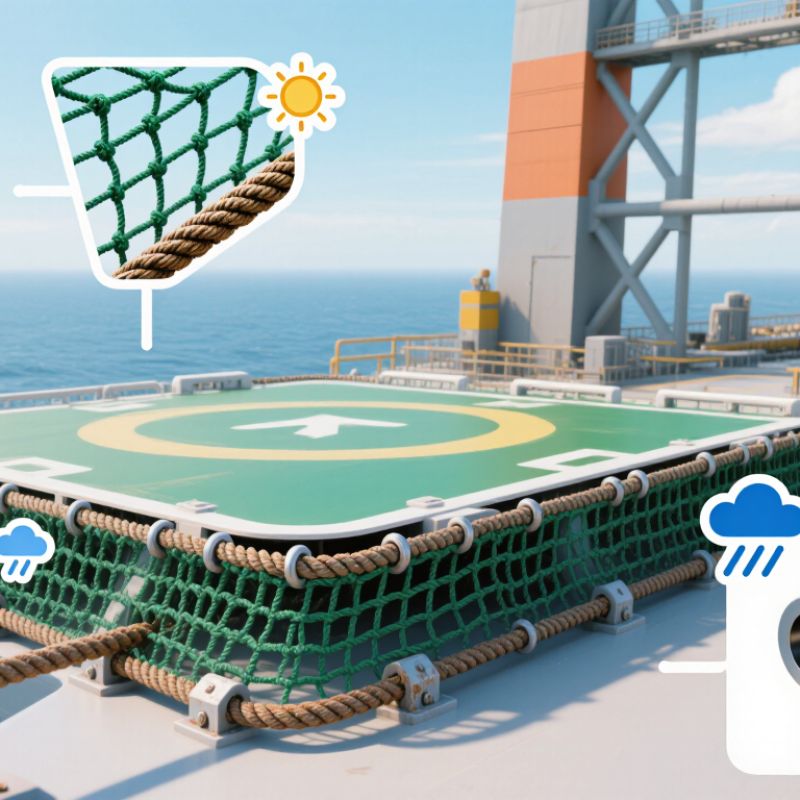
Choosing a China helideck safety net supplier starts with the requirements, not the catalogue. CAP 437 requires a safety net to extend at least 1.5 metres beyond the helideck perimeter. It should remain below deck level and provide a firm, continuous fall-protection surface. ICAO Annex 14, Volume II, also requires protective arrangements around helicopter landing areas where an edge hazard exists. These dimensions must match the approved helideck design.
Ask each supplier for drawings, material certificates, load-test records, and installation tolerances. Stainless steel, coated steel, and synthetic rope behave differently under salt spray, ultraviolet exposure, and repeated tension. A useful procurement file should record mesh size, rope diameter, fixing-point spacing, net deflection, and replacement intervals. CAP 437 and ICAO Annex 14 provide the compliance framework, but local aviation authorities may impose additional conditions. Check those conditions early.
CAP 437
ICAO Annex 14
Factory audits reveal practical differences. Inspect crimped terminals, edge ropes, weld quality, drainage, and traceable batch numbers. Request evidence from recognized laboratories, not only internal test sheets. IOGP aviation guidance also stresses documented competence, maintenance control, and operational assurance. A low quotation can hide unsuitable fixings or weak corrosion protection. I have seen specifications copied without considering deck curvature. That is a real weakness. Require a site-specific calculation and a trial installation before shipment. A catalogue photograph proves very little. Supplier selection should reward controlled production, transparent records, and the ability to correct design errors before the net reaches the helideck.
How to Choose the Best China Helideck Safety Net Supplier
The 1.5 m projection is not a marketing detail. It is a critical design dimension. UK CAA CAP 437 states that helideck safety nets should project at least 1.5 m beyond the landing area edge. ICAO Annex 14, Volume II also stresses clear approach paths and controlled obstacle hazards. Always confirm which authority governs your installation.
Ask the supplier for a dimensioned drawing. It should show the deck edge, net frame, support brackets, access points, and surrounding structures. The net should remain taut and avoid creating trip hazards or snag points. Check its elevation carefully. A badly positioned net can reduce practical clearance, even when the projection measures 1.5 m. That detail is often missed. Request material certificates, corrosion-test results, mesh specifications, and documented load testing. Factory photos help, but they are not proof.
Tips: Measure the finished steelwork, not only the design drawing. Require a site survey before fabrication. Compare the supplier’s geometry with CAP 437 and local aviation requirements. Ask for installation tolerances in millimetres. A small error at several brackets can become a large perimeter problem. I would also inspect drainage, fasteners, and sharp edges during handover. Suppliers sometimes focus on the net fabric and overlook the supporting frame. That is a weakness worth challenging. Records should identify inspection dates, test methods, and responsible engineers. Needlessly broad claims deserve caution.
| Evaluation Dimension | Required or Recommended Value | What to Verify with the Supplier | Acceptance Evidence |
|---|---|---|---|
| Horizontal safety-net projection | At least 1.5 m beyond the outer edge of the landing area or deck structure, where required by the applicable aviation standard. | Check that the 1.5 m dimension is measured horizontally from the deck edge to the outer edge of the net, not from an intermediate support or handrail. | Dimensioned general-arrangement drawing, certified site measurement, and installation inspection report. |
| Net inclination | The net should slope downward and outward from the deck edge; under commonly applied offshore helideck guidance, the slope is generally limited to approximately 10° below horizontal. | Confirm the proposed angle against the project’s civil-aviation authority, helideck certification basis, and operating environment. | Approved geometry drawing, calibrated angle measurement, and authority or consultant review. |
| Outer-edge vertical position | For designs following widely used offshore helideck guidance, the outer edge is typically positioned no more than 250 mm below the level of the landing area. | Verify the vertical offset at several points, especially at corners, transitions, access areas, and locations affected by structural deflection. | Cross-section drawings, level survey, and signed installation checklist. |
| Clearance below the net | The net should not create an avoidable snagging, falling-object, or access hazard. Clearance must suit the deck structure and the approved rescue or maintenance arrangement. | Request a complete section drawing showing beams, brackets, drains, lighting, walkways, and any equipment below the net. | Coordinated construction drawing and on-site obstruction inspection. |
| Mesh opening and rope layout | Use a consistent mesh pattern and perimeter rope arrangement suitable for preventing a person’s foot or body from passing through the net. The final opening size must match the selected safety-net standard and risk assessment. | Check measured mesh openings, border-rope continuity, stitching quality, and whether the design has been tested as a complete system. | Product drawing, material specification, test report, and sample inspection. |
| Design load and energy absorption | The complete net, supports, fasteners, and deck connections must be designed for the applicable personnel-fall and environmental loads. A single net-panel rating is not sufficient. | Ask for system-level calculations covering the net, support brackets, edge beams, anchors, and load transfer into the deck. | Structural calculation, test certificate, load-case schedule, and connection details. |
| Material and environmental resistance | Materials should withstand ultraviolet exposure, salt spray, moisture, temperature variation, and repeated wet-dry cycles expected at the installation site. | Confirm material type, coating or treatment, corrosion category, UV resistance, and compatibility between ropes, mesh, brackets, and fasteners. | Material certificates, corrosion-protection specification, durability data, and maintenance instructions. |
| Support spacing and edge fixing | Support spacing must be established by structural calculation and should maintain the required 1.5 m projection without excessive sag or local gaps. | Review support spacing, corner reinforcement, fixing-point capacity, bolt grade, weld details, and tolerance allowances. | Fabrication drawings, welding or bolting records, torque records, and installation photographs. |
| Drainage and water retention | The geometry should allow water to drain freely and should not form permanent pockets that increase weight, ice loading, corrosion, or deterioration. | Inspect low points, net tension, drainage paths, and the effect of rain, spray, and snow or ice where applicable. | Drainage detail, slope verification, and commissioning inspection. |
| Helicopter access and operational clearance | The net and its supports must remain outside the approved landing-area boundary and must not obstruct approach paths, visual aids, lighting, firefighting equipment, or emergency routes. | Coordinate the net layout with the helideck marking plan, obstacle limitation requirements, lighting layout, and emergency response plan. | Approved helideck layout, obstacle review, and final operational inspection. |
| Inspection and replacement planning | Provide routine inspection intervals, damage criteria, repair methods, and replacement procedures for the net, ropes, brackets, and fasteners. | Confirm whether individual panels can be replaced without removing the complete perimeter system and whether spare components are identifiable. | Inspection manual, inspection checklist, spare-parts list, batch traceability, and maintenance records. |
Note: The 1.5 m projection and geometric values shown above are commonly used helideck safety-net criteria. Final dimensions must be confirmed against the governing civil-aviation authority, project specification, approved helideck design, and site-specific structural calculations.
Material verification should begin before price comparison. Ask for the exact wire grade, diameter, tensile strength, and manufacturing specification. Marine environments demand more than attractive stainless steel claims. Confirm whether the net uses 316L stainless steel or hot-dip galvanized high-tensile steel. Request mill certificates, batch numbers, and traceability records. The supplier should connect each certificate to the delivered net.
Look closely at corrosion protection. Salt spray results can help, but they do not represent every offshore condition. Examine coating thickness, weld quality, cut edges, drainage points, and contact between dissimilar metals. Poorly sealed joints may rust first. Ask how the supplier prevents crevice corrosion around clamps and perimeter fittings. Small details matter. A clean surface can still conceal weak treatment beneath it.
Load-test documentation needs careful review. A credible report identifies the test date, net dimensions, test load, loading method, deflection, and acceptance criteria. It should also name the calibrated equipment and responsible testing organization. Do not accept a single photograph as proof. Compare the tested design with your actual installation, including anchor spacing and fixing hardware. A certificate may look complete yet omit key assumptions. That omission deserves questions, not trust. Some suppliers may provide excellent paperwork but limited production control, so request recent inspection records and sample evidence from the same manufacturing batch.
Choosing a China-based helideck safety net supplier requires more than comparing quotations. In field reviews, I look for controlled production, clear records, and evidence matching the delivered net. ISO 9001 certification is useful, but it does not prove product performance. Check the certificate scope, issuing body, validity dates, and covered factory address. Ask how design changes, nonconforming materials, and corrective actions are controlled. Good answers are specific. Vague promises deserve caution.
Traceability should begin with incoming wire, fittings, and mesh components. Each batch should connect to purchase records, inspection results, production operators, and final release documents. Request sample records, not prepared statements. A reliable supplier can identify the batch number behind one finished panel. Check tensile, dimensional, seam, corrosion-protection, and load-test reports against the agreed specification. Test methods and equipment calibration dates matter. Missing calibration details are a warning.
A factory inspection should follow the process, not only the showroom. Walk through material storage, cutting, stitching or welding, tensioning, labeling, and packing. Look for segregated rejected materials and readable inspection tags. Speak with quality staff separately from sales personnel. Photographs help, but they cannot replace witnessed checks. I have seen neat samples hide inconsistent production. That possibility deserves attention. An independent pre-shipment inspection can verify quantities, workmanship, markings, and documents before dispatch. Leave room for correction.
How to Choose the Best China Helideck Safety Net Supplier
Certification should be verified before comparing prices. A reliable supplier provides current test reports, material specifications, and traceable batch records. Ask which standards apply to the net, fittings, stitching, and corrosion protection. Do not accept a certificate alone. During project inspections, I have seen complete-looking documents with mismatched dimensions. Request samples and compare them with the approved drawings. Small gaps can create serious maintenance concerns.
Delivery capacity needs proof beyond promises. Request a production schedule, monthly output, backup processes, and inspection checkpoints. For a helideck project, late netting can delay installation and disrupt other contractors. Ask for realistic lead times, packaging details, and progress updates. A factory audit, even by video, can reveal storage problems or limited equipment. Photographs help, but they are not evidence. Leave room for mistakes. I once underestimated packaging quality, and damaged corners caused avoidable rework.
Warranty terms should define coverage, response time, replacement procedures, and exclusions. Read the exclusions carefully. Confirm whether ultraviolet exposure, salt spray, stitching failure, and fitting corrosion are included. A low purchase price may hide frequent replacement, difficult installation, or expensive freight. Compare expected service life, inspection labor, cleaning needs, spare parts, and disposal costs. A net lasting five extra years may offer better value. Still, lifecycle estimates remain imperfect because weather and rotor wash vary by site. Choose a supplier willing to review field feedback and adjust recommendations.
It should extend at least 1.5 metres beyond the approved landing-area perimeter. A small error matters.
The net should remain below deck level and form a firm, continuous fall-protection surface. It must not create trip hazards.
Request dimensioned drawings showing the deck edge, support brackets, net frame, access points, and nearby structures.
Check mesh size, rope diameter, fixing spacing, corrosion protection, and expected performance under salt spray and ultraviolet exposure.
Inspect edge ropes, crimped terminals, welds, drainage, fasteners, and traceable batch numbers. Photos alone prove little.
Finished steelwork may differ from design drawings. A site survey confirms curvature, bracket positions, clearances, and installation tolerances.
Ask for current material certificates, laboratory test reports, load-test records, corrosion results, and inspection dates.
Request a production schedule, monthly output, inspection checkpoints, packaging details, and backup arrangements. Promises are not enough.
Confirm coverage for ultraviolet exposure, salt spray, stitching, fitting corrosion, replacement procedures, and response times.
Include installation labor, inspections, cleaning, spare parts, freight, disposal, and expected replacement intervals. Longer service life may still be uncertain.
Choosing the right China Helideck Safety Net supplier requires more than comparing prices. Start by defining the net’s intended use, dimensions, edge configuration, and performance requirements in line with CAP 437 and ICAO Annex 14. Confirm that the design provides the required 1.5 m safety-net projection and that installation geometry, support spacing, attachment points, and clearance from the helideck are suitable for safe helicopter operations.
Next, verify the use of corrosion-resistant materials and request documented load-test results, inspection records, and material certificates. A reliable supplier should demonstrate ISO 9001 production controls, clear product traceability, consistent quality inspections, and the ability to support factory audits. Finally, compare certification completeness, manufacturing and delivery capacity, warranty terms, replacement support, and total lifecycle cost. The best choice is a supplier that combines regulatory alignment, durable construction, transparent documentation, dependable delivery, and long-term technical support rather than simply offering the lowest initial quotation.

LvXing