China’s aluminum profile market includes large extrusion groups, regional manufacturers, and specialist fabricators. Their catalogs may look similar. Their capabilities often are not. For buyers comparing suppliers, the real questions sit on the factory floor: Can the press hold the required dimensions? Are alloy and temper documented? Can anodizing match the sample across repeat orders? Small differences matter. A profile that arrives with uneven coating or inconsistent wall thickness can slow assembly and increase rework.
Industry Aluminum Profile sourcing specialist Chen Wei offers this practical reminder: “A supplier’s true quality is not the sample on the desk; it is the consistency of the next thousand profiles.” Treat that as a guiding principle, not a substitute for verification. Request recent inspection records, confirm tooling ownership, and ask how the supplier controls extrusion, finishing, packing, and delivery. Where possible, compare physical samples against drawings and stated tolerances. A polished brochure is not evidence. Neither is the lowest quote.
This guide examines leading Chinese suppliers through practical buyer criteria, including product range, production capability, quality controls, customization, and communication. It also recognizes an imperfect reality: supplier information can be difficult to compare, and public claims may not tell the whole story. Use the shortlist to focus your research, then verify important details directly. A good match should fit the application, budget, and delivery schedule—not simply look impressive online.
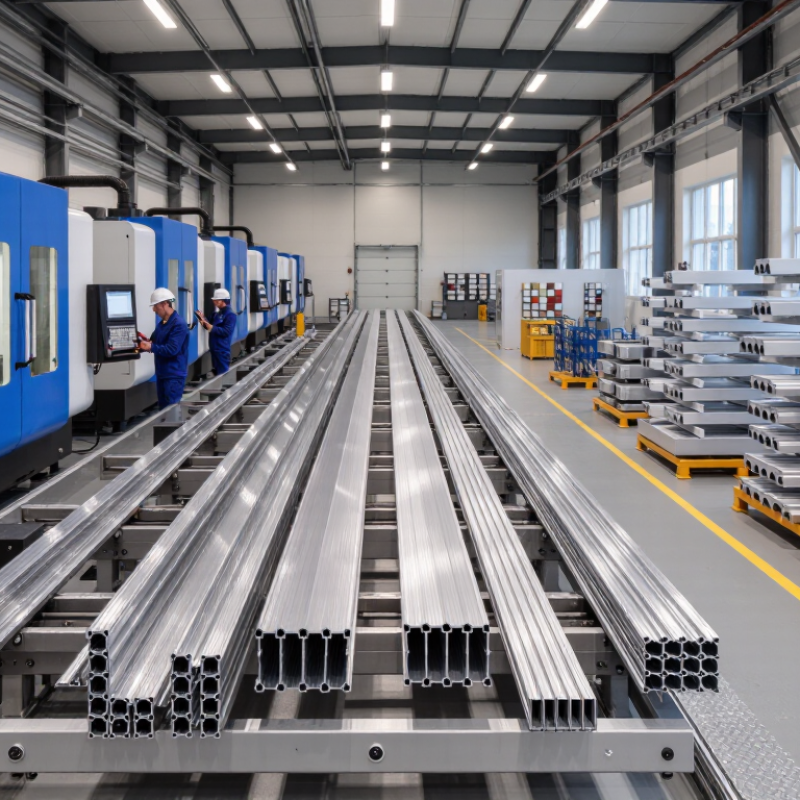
Industrial aluminum profiles are long, uniform shapes formed by pushing a heated aluminum billet through a shaped steel die. This process, called extrusion, can produce channels, rails, frames, and heat sinks with consistent cross-sections. The profile’s design determines its strength and function: thick walls can support loads, while narrow fins help release heat. Yet a clever shape cannot compensate for poor alloy selection or inaccurate tolerances.
Manufacturing starts with alloy selection and billet heating. A hydraulic press then forces the billet through the die; the emerging profile is cooled, stretched straight, cut, and often heat-treated. Surface finishing may include anodizing or powder coating, depending on the application.
Small flaws matter. Die wear, uneven cooling, or incorrect stretching can cause bends and dimensional variation. The International Aluminium Institute reported global primary aluminum production of about 70.6 million tonnes in 2023, reflecting the scale of the material supply behind products such as extrusions. Its data describes primary metal, not profile output—a distinction buyers should keep in mind.
During supplier reviews, ask for alloy and temper certificates, dimensional inspection records, and checks for straightness and surface defects. These details are less visible than a polished sample, but they reveal more about consistent production. Perfect results are not automatic; process control still needs careful attention.
China’s industrial aluminum profile supply market serves machinery builders, automation integrators, and construction-equipment manufacturers. Suppliers may offer standard extrusions, custom cross-sections, cutting, drilling, and surface finishing. A profile’s suitability depends on more than its shape. Alloy, temper, wall thickness, straightness, and intended load all affect performance.
The details matter. A small mounting slot can decide whether an assembly fits without rework. Buyers should provide drawings, tolerances, expected quantities, and finish requirements before comparing quotations. Ask how dimensions are checked and whether inspection records can be shared. A clear answer is more useful than a broad promise.
Production capability varies between suppliers. Some focus on large-volume extrusion; others handle smaller batches and secondary machining. Request a sample made to the actual specification, not just a similar catalog item. Check the cut edges, hole positions, and finish under consistent lighting. Even careful checks have limits: batches may show slight color differences, and a sample cannot prove every production run will match. Lead time also includes tooling, finishing, packing, and transport, so confirm each stage before setting a delivery date.
Leading industrial aluminum profile suppliers in China serve manufacturers that need consistent dimensions, dependable production, and practical technical support. Their capabilities may include extrusion, cutting, drilling, CNC machining, and surface treatments such as anodizing or powder coating. The right fit depends on the drawing, alloy, order volume, and operating environment—not simply a supplier’s advertised capacity.
Review technical documents before placing a large order. Ask for alloy and temper details, dimensional tolerances, inspection records, and sample profiles made to your specifications. A trial order can reveal whether holes align, edges are clean, and the finish remains even across different sections. Small details matter. Clear answers about tooling costs, production schedules, packaging, and defect handling also help prevent avoidable delays. Factory audits or third-party inspections may provide useful evidence, though neither guarantees a flawless shipment. Some suppliers may excel at complex custom sections but be less flexible with small runs. That trade-off deserves an honest conversation. Compare documented performance with your own requirements, and leave room for a few imperfect assumptions to be checked against real samples.
Chinese industrial aluminum profile suppliers typically offer standard T-slot sections, custom extrusions, tubes, bars, and structural shapes. Buyers can request different alloys and tempers to balance strength, weight, and machinability. Surface options may include anodizing, powder coating, or mill finish. Cut-to-length service and drilled mounting holes can reduce work on the factory floor. Small details matter.
These products serve automation lines, warehouse shelving, solar mounting systems, machine frames, and transportation equipment. Construction projects may use profiles for window frames, partitions, and façade supports. Electronics manufacturers often need compact heat sinks or enclosures with precise dimensions. A suitable section depends on load, operating conditions, and how parts connect—not just the catalog drawing.
Before ordering, request drawings, tolerance information, material records, and samples where practical. Check whether the supplier can maintain consistent dimensions across repeat batches. A sample may fit perfectly, while production pieces reveal variation; that is worth discussing early. Not every catalog explains finish durability or machining limits clearly. Ask for specifics, and compare them against the actual installation requirements.
Illustrative qualitative index of common applications, not market-share or sales data.
Suppliers commonly offer architectural profiles for windows and curtain walls, as well as industrial sections for machinery frames, heat sinks, solar-panel mounting, and transport components. Actual product ranges vary by supplier and project requirements.
When comparing industrial aluminum profile suppliers in China, ask for evidence from the production floor, not only a polished certificate. The International Aluminium Institute reported global primary aluminum production of about 70.6 million tonnes in 2023. That scale makes process control essential, but the figure does not measure any supplier’s performance. Request inspection records for alloy composition, wall thickness, straightness, and surface finish. Check a physical sample for die lines, sharp edges, and coating consistency. Numbers help. Ask how measurement tools are calibrated and how defects are recorded. A neat audit file can still miss problems between batches.
For customization, provide drawings with alloy, temper, tolerance, finish, and packaging requirements. Ask whether the supplier can make a trial run before committing to full-volume production. Confirm who controls the extrusion die and what changes trigger new tooling costs. Delivery claims need the same scrutiny. Request recent lead-time records, monthly capacity by profile type, and examples of how delays were communicated. Clarify whether quoted times cover extrusion only or also finishing, inspection, and shipping. Not enough. A supplier may quote a fast schedule, yet leave little room for die changes or rework. Compare promised dates with actual dispatch records and inspect how profiles are protected from scratches during transit.
Check alloy, temper, wall thickness, straightness, and expected load. Shape alone is not enough.
Provide drawings, tolerances, quantities, and finish requirements. Include mounting details where possible. Small slots matter.
Suppliers may offer T-slot sections, custom extrusions, tubes, bars, and structural shapes. Options vary.
They support automation lines, shelving, solar systems, machine frames, and transportation equipment. Construction and electronics use them too.
Many offer cutting, drilling, anodizing, powder coating, or mill finish. Confirm which services match your specifications.
Compare dimensions, hole positions, cut edges, and surface finish. Use consistent lighting. It helps, but it is not proof of every batch.
Ask about dimension checks and inspection records. Discuss sample-to-production differences before placing an order. Some variation may remain.
Tooling, finishing, packing, and transport all contribute. Confirm each stage before setting a delivery date. Estimates can still shift.
Industrial aluminum profiles are produced by shaping aluminum through extrusion, followed by processes such as cutting, surface finishing, and quality inspection. China’s extensive manufacturing network supports a broad supply market, with suppliers serving needs ranging from standard structural components to custom-designed profiles. Their products are used in sectors such as machinery, transportation, construction, electronics, and renewable energy, where strength, precision, and adaptability are important.
When comparing suppliers, buyers should consider material consistency, dimensional accuracy, production capacity, and documented quality-control procedures. It is also useful to assess whether a supplier can support design adjustments, provide suitable finishing options, and communicate clearly throughout the order process. Reliable delivery depends on realistic lead times, efficient production planning, and secure packaging. A careful evaluation helps buyers select an Industry Aluminum Profile supplier whose capabilities match their technical requirements, budget, and schedule.

LvXing