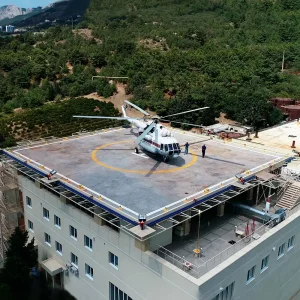
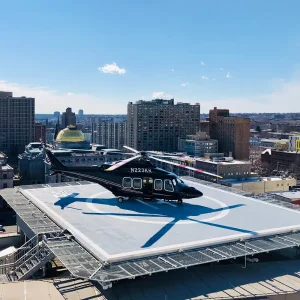
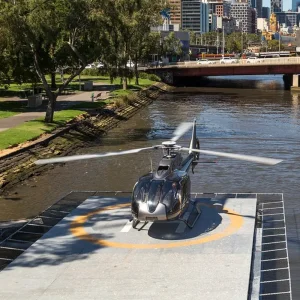
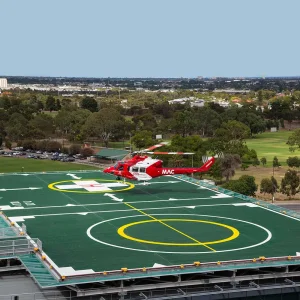
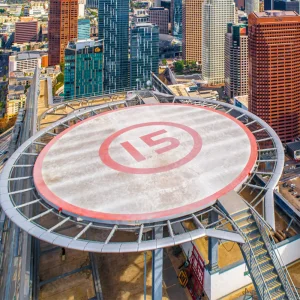
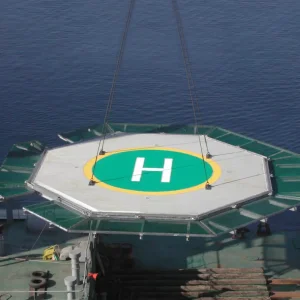
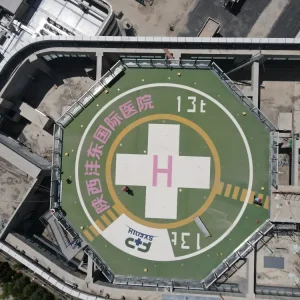
Engineered for extreme offshore conditions, providing certified structural safety and corrosion resistance.
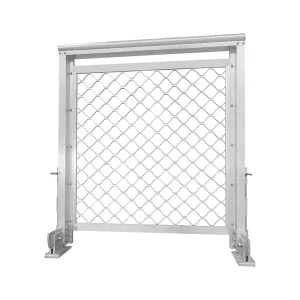
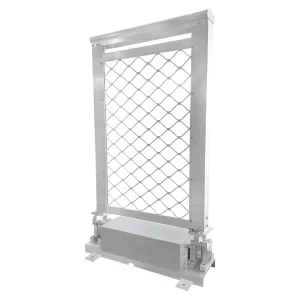
As the largest economy and leading oil producer in Africa, Nigeria continues to expand its maritime and onshore infrastructure. The deepwater operations in the Gulf of Guinea, paired with rapid high-rise developments in Lagos (such as Eko Atlantic and Victoria Island) and administrative expansion in Abuja, demand high-grade helicopter landing infrastructure. Safety is the primary metric in this sector.
Operating an offshore helideck on an FPSO (Floating Production Storage and Offloading) unit or a jack-up rig requires absolute adherence to rigorous international standards. CAP 437 (Standards for Offshore Helicopter Landing Areas) and ICAO Annex 14 dictate the exact physics, dimensions, and mechanical safety barriers necessary to prevent catastrophic landing failures.
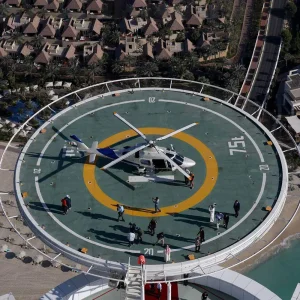
Helideck perimeter safety nets are crucial life-saving systems. They must surround the landing area to catch personnel or equipment in the event of a slip or slide, without presenting an obstacle to the aircraft itself. In Nigeria's humid, high-saline marine environments (such as Port Harcourt and Warri coastal regions), material degradation is a severe risk. Traditional steel nets quickly succumb to pitting and oxidation.
Our structural engineering utilizes marine-grade, high-tensile aluminum alloys (mainly 6000-series like 6082-T6 and 6061-T6), which naturally form a protective oxide layer. Coupled with stainless steel 316 fittings, these lightweight, corrosion-proof structures ensure a service life exceeding 25 years with minimal maintenance.
Tested, certified, and trusted globally for critical industrial infrastructure.
The design of helideck perimeter safety systems has evolved from passive, manual-folding wire frames to smart, motorized, and modular safety boundaries. Under harsh offshore operations, manual nets can be slow to adjust, increasing deployment risk.
Our R&D team at LvXing Intelligent Equipment Co., Ltd. has introduced motorized electric safety nets that can be controlled remotely from the bridge or control station. This reduces on-deck operations, keeping deck crews safe from rotor wash and harsh sea states.
Sub-Saharan African maritime operations experience elevated temperatures and continuous exposure to UV and atmospheric salt. Our manufacturing utilizes Fenglu premium aluminum profiles, processed through high-precision heat-treatment furnaces to yield T6 temper ratings. This creates the optimal micro-structure to resist stress corrosion cracking (SCC) under heavy ocean winds and potential impact.
Lvxing specializes in high-quality structural aluminum solutions for critical global infrastructure.
Established in 2015 and located in Foshan City, Guangdong, LvXing Intelligent Equipment Co., Ltd. boasts a skilled R&D team with extensive experience. We leverage exceptional technical expertise to effectively transform customers' ideas into reality, consistently meeting their precise requirements.
We utilize premium Fenglu aluminum, offering a diverse range of profiles for flexible applications. Our extrusion lines, ranging from 800T to 20,000T, accommodate alloys 1xxx, 2xxx, 3xxx, 5xxx, 6xxx, and 7xxx, allowing us to produce shaped products with section dimensions up to 1.2 meters in width and 28 meters in length. These products are recognized for their precision and meticulous processing, finding broad application in aerospace, military, medical, and industrial sectors.
Our commitment to excellence is evident throughout the manufacturing process, rigorous quality control, thorough packaging, and efficient shipping procedures. This dedication has earned us recognition as a national excellent and honest enterprise, along with quality system certification in accordance with GB/T19001-2016/ISO9001:2015 standards.
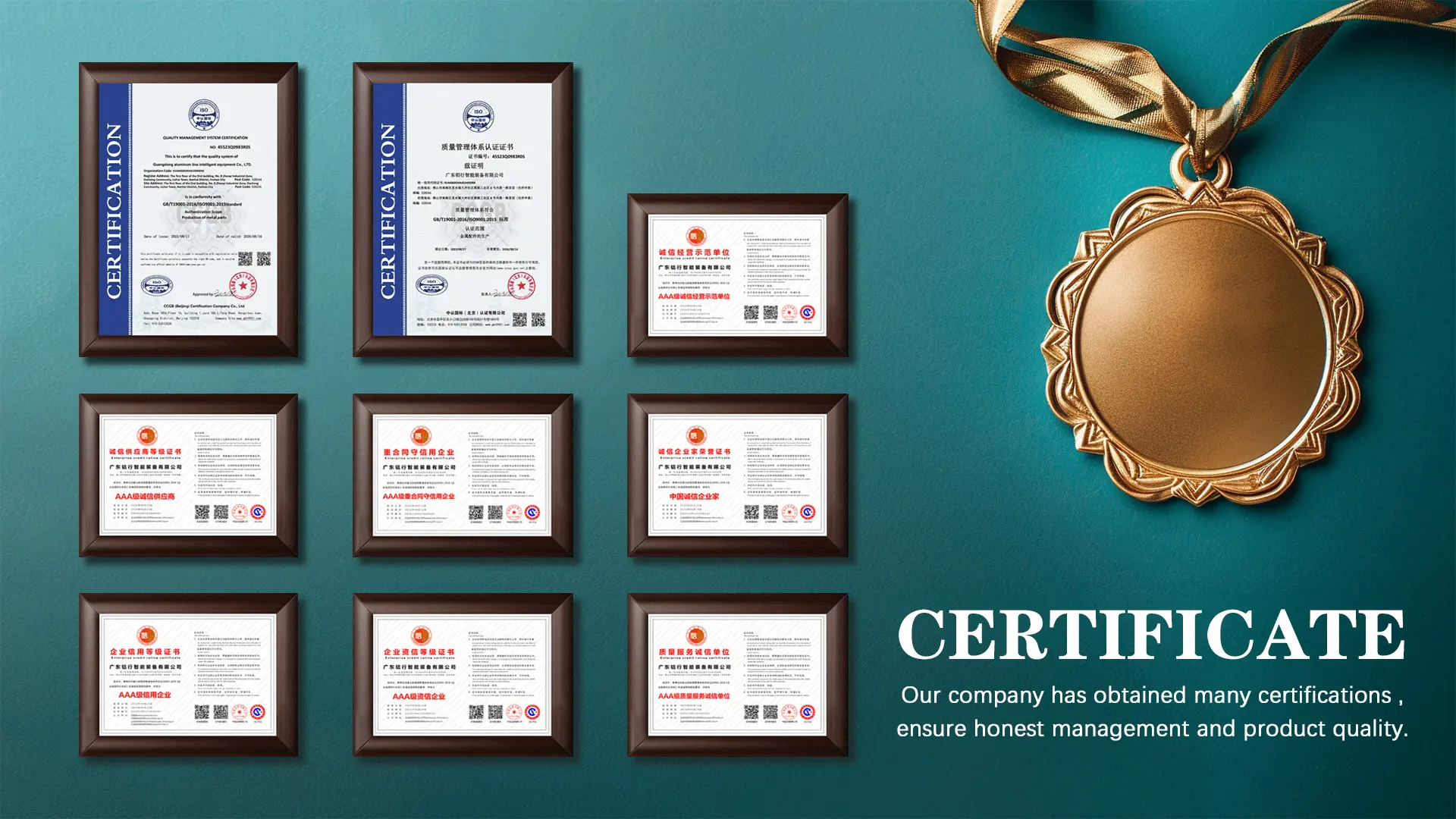
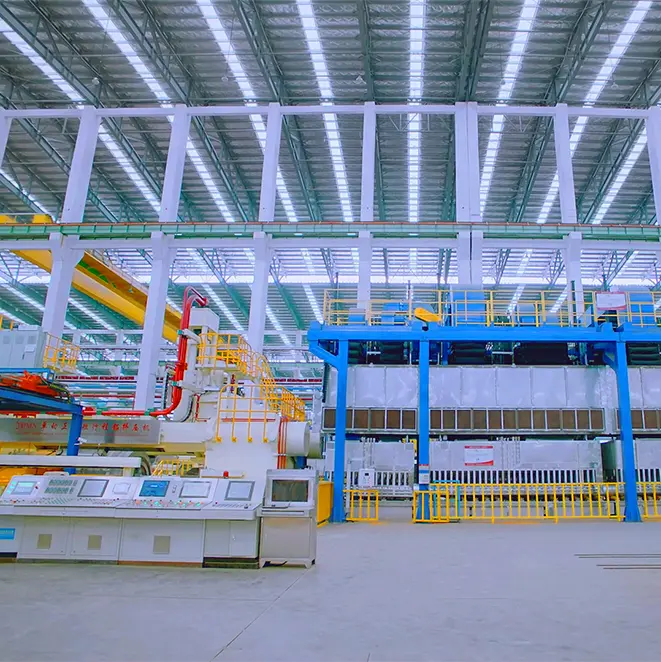

We have obtained the “Special Aluminium Materials for Aerospace” Certificate, ensuring quality and material safety under complex stress profiles.
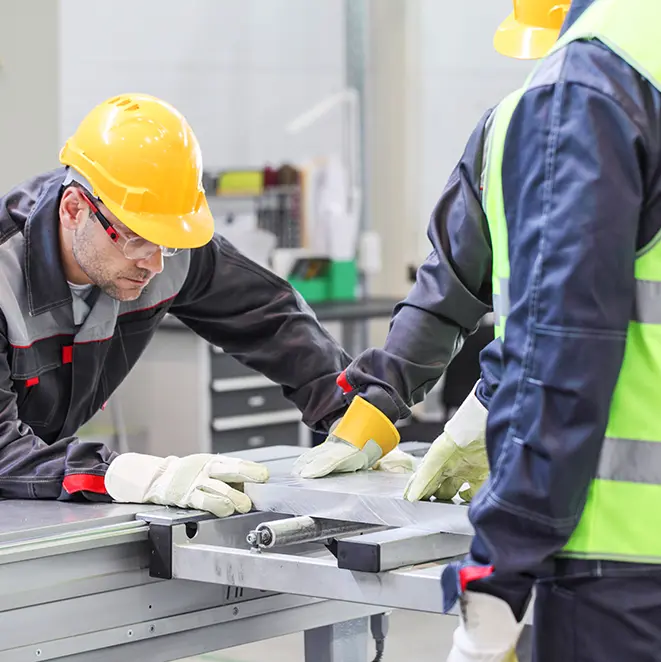

Extrusion lines ranging from 800T to 20,000T for 1xxx to 7xxx alloys. Fully shaped products with dimensions up to 1.2m width or 28m length.
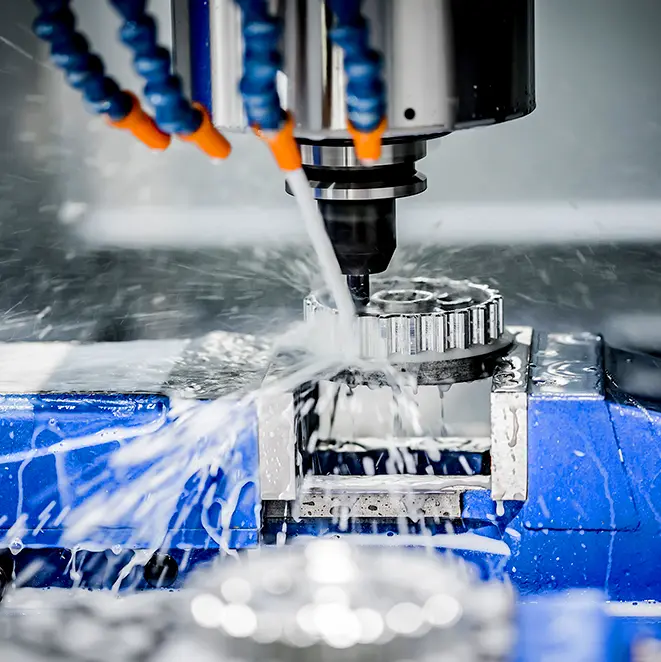

Our engineering team converts conceptual client requirements into structural projects, identifying issues to supply compliant installations.
LvXing Intelligent Equipment utilizes modern automation to streamline processes. Our factory in Foshan, Guangdong employs advanced CNC machining, automated extrusion handling, and real-time QA testing. This reduces manufacturing lead times by up to 35% compared to European or North American counterparts.
For engineering firms in Lagos, Port Harcourt, and Warri, importing custom structural components can present logistics challenges. We mitigate these risks by coordinating with international logistics partners to ship cargo directly from Guangzhou or Shenzhen ports to Apapa Port or Tin Can Island Port in Lagos, as well as Port Harcourt Onne Port.
Long ocean transits through hot, tropical waters require robust protection. Every aluminum panel, net segment, and accessory is packed in custom, steel-framed wooden crates, lined with heavy-duty vapor barrier plastic and desiccants. This ensures that when your helipad structure arrives at your construction site in Nigeria, it is free from cosmetic defects, scratches, or humidity stains.
Select from our standard CE certified product configurations tailored for African projects.
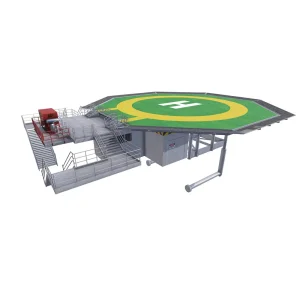
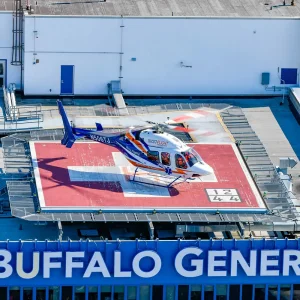
Custom shapes, modular frames, and maritime structural variants.
Managing procurement for oil and gas projects in Nigeria requires balancing cost efficiency with strict safety standards. Standard aluminum helideck packages, which include structural frames, perimeter safety nets, and lighting, are capital-intensive. Working directly with Chinese manufacturing firms like LvXing can reduce capital expenditure (CapEx) by 20% to 35% compared to purchasing through European middlemen.
Our manufacturing facility is equipped to handle large-scale custom profiles. By utilizing Fenglu raw aluminum billets, we manage the supply chain from raw material to final fabrication. This control ensures consistent metallurgical quality and structural strength.
To secure an accurate project quote, technical procurement teams should provide the following parameters:
Technical details, certifications, and compliance clarifications.
 LvXing